Weight is the first specification a bowler feels and the easiest one to get wrong. Pick a ball that is too heavy and your swing breaks down halfway through a session, timing goes with it, and your wrist and shoulder pay the bill the next morning. Pick one that is too light and the ball deflects off the pins instead of driving through them, leaving corner pins standing on shots that looked perfect off your hand. The good news is that finding the right weight is not guesswork; a couple of simple rules get almost everyone into the right neighborhood, and a few adjustments finish the job.
Start With the 10 Percent Rule
The oldest rule of thumb is still the best starting point: choose a ball weight equal to roughly 10 percent of your body weight, up to the legal maximum. A 150-pound bowler lands near 15 pounds, a 120-pound bowler near 12, and anyone above about 160 pounds bumps into the ceiling. That ceiling is fixed. The United States Bowling Congress caps sanctioned balls at 16 pounds, and while balls are manufactured down to about 6 pounds for children, no legal ball goes heavier than 16 no matter how strong you are.
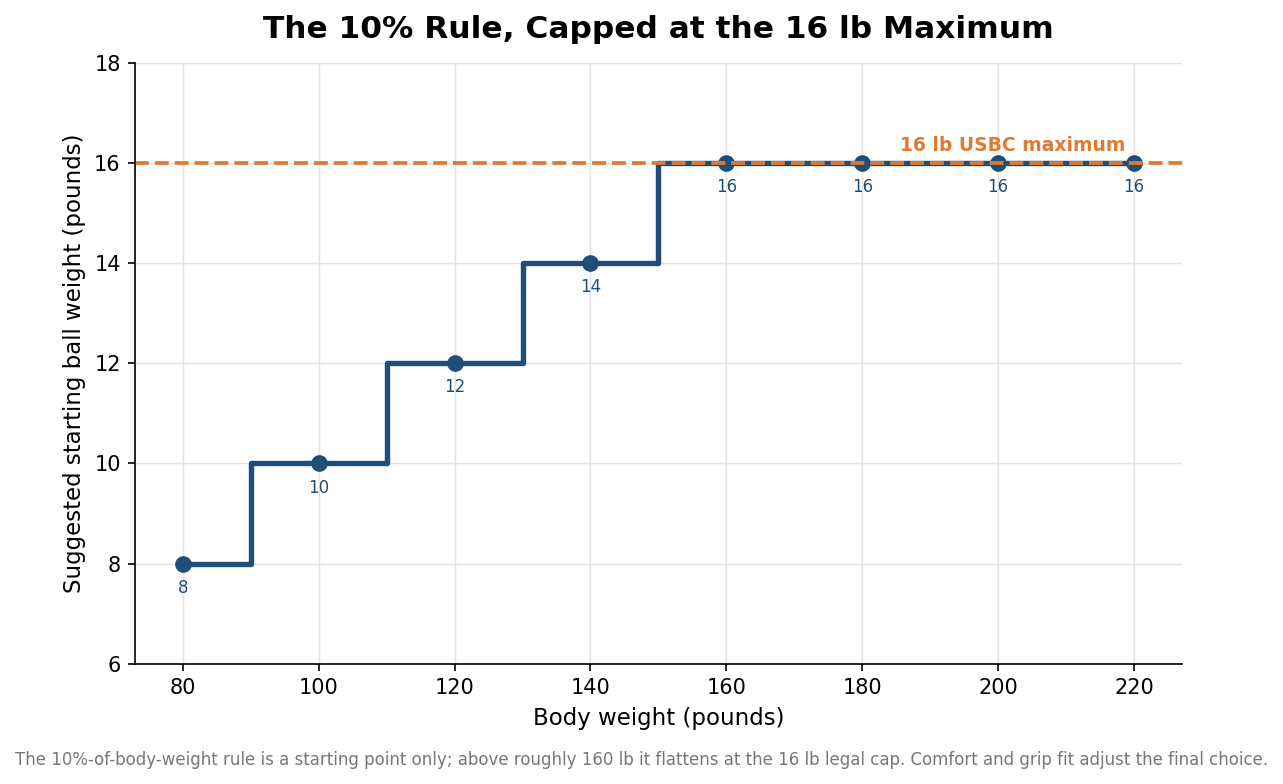
Treat the number as a floor to reason from, not a verdict. The rule assumes an average build and an average delivery, and it says nothing about your grip strength, your shoulder health, or how the ball is drilled. It answers the question “where do I start,” and the rest of this guide answers “where do I end up.”
Then Adjust for Who Is Throwing It
Age, strength, and how competitively someone bowls all pull the starting number up or down. Children generally do well with a ball weighing roughly one pound per year of age, which puts most six-to-ten-year-olds somewhere between 6 and 10 pounds. Teens typically move into the 10-to-14-pound range as they grow. Among adults, casual women bowlers are usually comfortable around 10 to 13 pounds and league women around 13 to 15, while casual men tend toward 13 to 15 pounds and competitive league men toward 15 to 16. Senior bowlers often step back down into the 10-to-14-pound range as they trade a little momentum for a swing they can repeat painlessly all night.
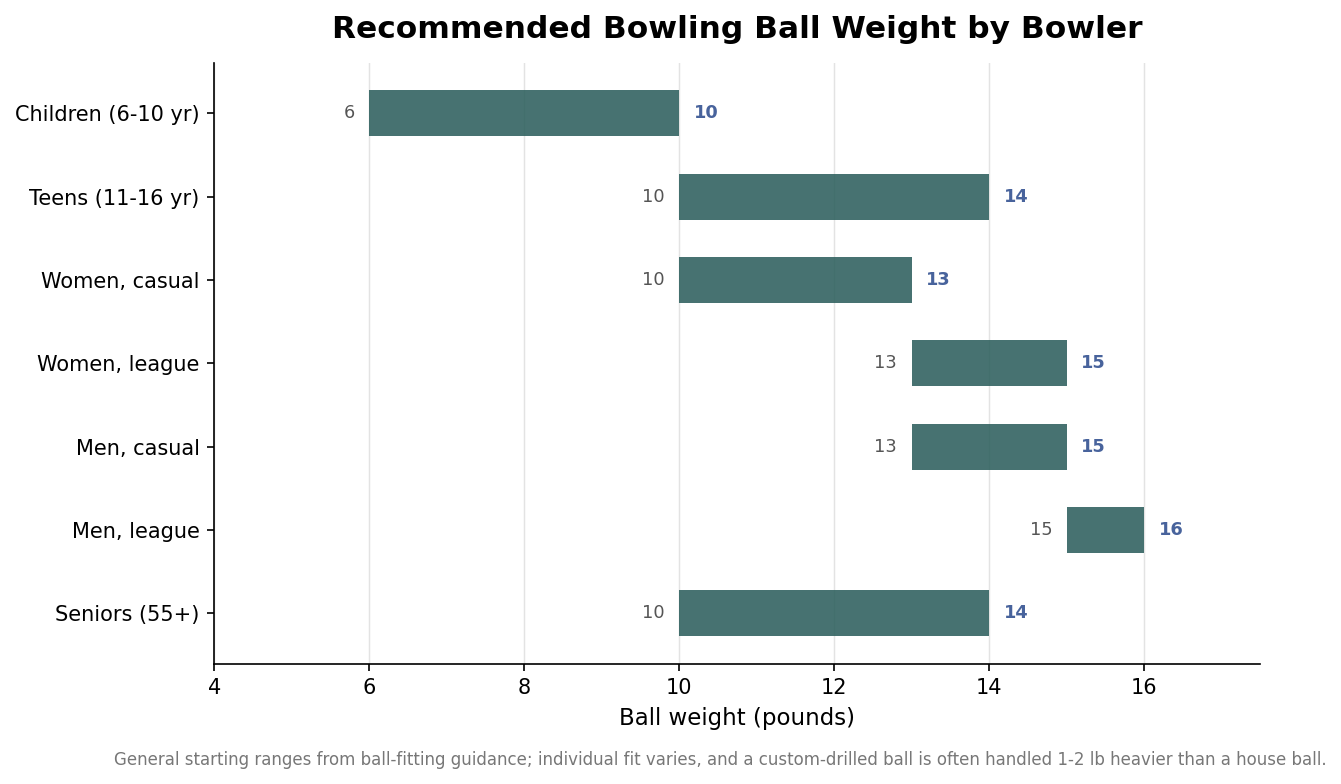
These bands overlap on purpose. A strong, athletic newcomer might start at the top of their range, while someone returning after a long layoff should start at the bottom and work up. If you are genuinely on the line between two weights, go lighter. A ball you can control through the last frame of the last game beats a heavier one that erodes your accuracy after game one.
A Drilled Ball Is Not a House Ball
One of the most common mistakes is choosing a custom ball’s weight based on the house ball you throw comfortably. They are not the same tool. A house ball uses a conventional grip, where your fingers sink in to the second knuckle, so you are essentially gripping with your fingertips and palm and hanging on for dear life. A custom ball is drilled to your hand, usually with a fingertip grip and pitches matched to your span, which spreads the load and lets the ball hang off your fingers rather than being squeezed.
Because a fitted ball is easier to hold, most bowlers can handle one to two pounds more than their usual house ball. A bowler who reaches for a 14-pound house ball will often throw a custom 15 comfortably and throw it better, because the extra pound of pin carry arrives without the extra grip fatigue. This is exactly why so many people who “always used 14” end up happiest at 15 once they get their first drilled ball, and it is worth planning for when you order rather than discovering after the fact.
What Weight Buys You on the Lane
Weight is a set of tradeoffs, not a simple more-is-better dial. A heavier ball carries more momentum into the pins, deflects less, and tends to leave fewer weak corner pins, which is why competitive bowlers gravitate toward the top of their range. The cost is effort and hook: a heavier ball is harder to rev up, so it generally produces a bit less total hook and demands more from your swing over a long block. A lighter ball is easier to spin, which can mean a higher rev rate and a more angular shape, but it also deflects more when it reaches the pins and punishes anything less than a clean hit.
This is why the professional ranks cluster at 15 and 16 pounds, and why the balance has shifted. Most touring pros now throw 15 pounds rather than 16, because modern ball and core technology delivers comparable pin action at the lighter weight while reducing the injury toll of throwing a heavy ball thousands of times. The lesson for everyone else is the same principle scaled down: pick the heaviest ball you can deliver with a smooth, repeatable swing, then stop. The last pound of pin carry is worthless if it costs you your timing or your wrist.
Buying Weight for a Group or in Bulk
Ordering for a league, a corporate event, a fundraiser, or a pro shop’s floor stock turns weight selection from a personal question into a distribution problem. A single group of adult bowlers will not all throw the same weight, and stocking only 15-pound balls guarantees that some people cannot use them. A practical assortment for a mixed adult crowd leans on 14 and 15 pounds as the core, with a meaningful number of 12s and 13s for lighter or casual bowlers and a smaller tail of 16s for the strongest arms. If children will bowl, add 6-to-10-pound balls, since nothing sours a young bowler faster than a ball they cannot lift.
Decide the drilling question before you order, not after. Balls bought for a specific person should be drilled to their hand, which is where the one-to-two-pound custom allowance comes into play, so collect each bowler’s usual comfortable weight and plan to size up where the fit supports it. Balls bought as promotional or event pieces are often left undrilled or drilled to a generic conventional grip, in which case you should size the assortment toward the more conservative house-ball weights people already know they can handle. Getting the spread right the first time is the difference between an order everyone can use and a pallet of balls that sit in the rack because they are all a pound too heavy for half the room.