Ordering a custom bowling ball raises a fair question before anyone drills a single hole: will the finished ball still be legal for sanctioned play? The short answer is that a personalized name, a printed logo, a swirl of custom color, or a company crest has no bearing on whether the ball passes inspection. What matters is the ball itself and how it is drilled. The United States Bowling Congress (USBC) certifies equipment against a published set of dimensional, weight, and hardness limits, and a ball that leaves the factory inside those limits stays legal no matter how it is decorated.
This guide walks through the specifications that actually govern legality, the two places where custom work can accidentally cross a line, and the 2026 rule change that has confused a lot of league bowlers who do not need to worry about it.
The numbers that define a legal ball
Weight is the specification everyone knows. A tenpin bowling ball may weigh no more than 16.00 pounds (7.26 kg). There is no enforced minimum in the rulebook, but the lightest balls in regular production are about 6 pounds, which is where most youth and lighter-arm bowlers start. A custom order does not change this ceiling; a 16-pound blank engraved with your logo is still a 16-pound ball.
Size is tightly bounded. A legal ball measures between 8.500 and 8.595 inches in diameter (21.59 to 21.83 cm), which works out to a circumference of 26.704 to 27.002 inches. That window is narrow on purpose so every ball fits the pin deck and the ball return the same way. Reputable blanks are molded to these figures, so as long as you buy a certified ball you never have to measure it yourself.
Surface hardness has a floor. The coverstock must register at least 72 on the Durometer D scale. This rule exists to stop bowlers from artificially softening a cover to grab more of the lane. Ordinary surface maintenance, sanding to a matte finish, or polishing to a shine all stay well within the rule; deliberately chemically softening a ball below 72 D does not.
None of these three limits is affected by decoration. Laser engraving a name into the coverstock, printing a full-color logo, or choosing a custom color blend changes the look of the ball, not its diameter, its weight, or its hardness reading.
Where custom work can actually matter: the drilling
The one part of a custom ball that touches the rulebook directly is the drilling, and here the rules changed meaningfully a few years ago. Balance holes are prohibited. Effective August 1, 2020, the USBC banned the extra non-gripping hole that drillers had long used to correct a ball’s static imbalance. Today every hole in the ball has to be a hole the bowler actually uses to grip it. A ball may have up to five holes for gripping, and if a hole is not used on every delivery it is treated as illegal.
Banning the balance hole created a problem: without it, drillers could no longer dial a ball’s static weights back toward zero. So the USBC loosened the static imbalance tolerances at the same time. Before the change, a ball could carry no more than 1 ounce of side weight and 1 ounce of finger or thumb weight, with 3 ounces allowed top to bottom. Since August 2020, all three of those tolerances sit at 3 ounces, which gives a driller room to lay out a custom grip without an extra hole to fix the leftover imbalance.
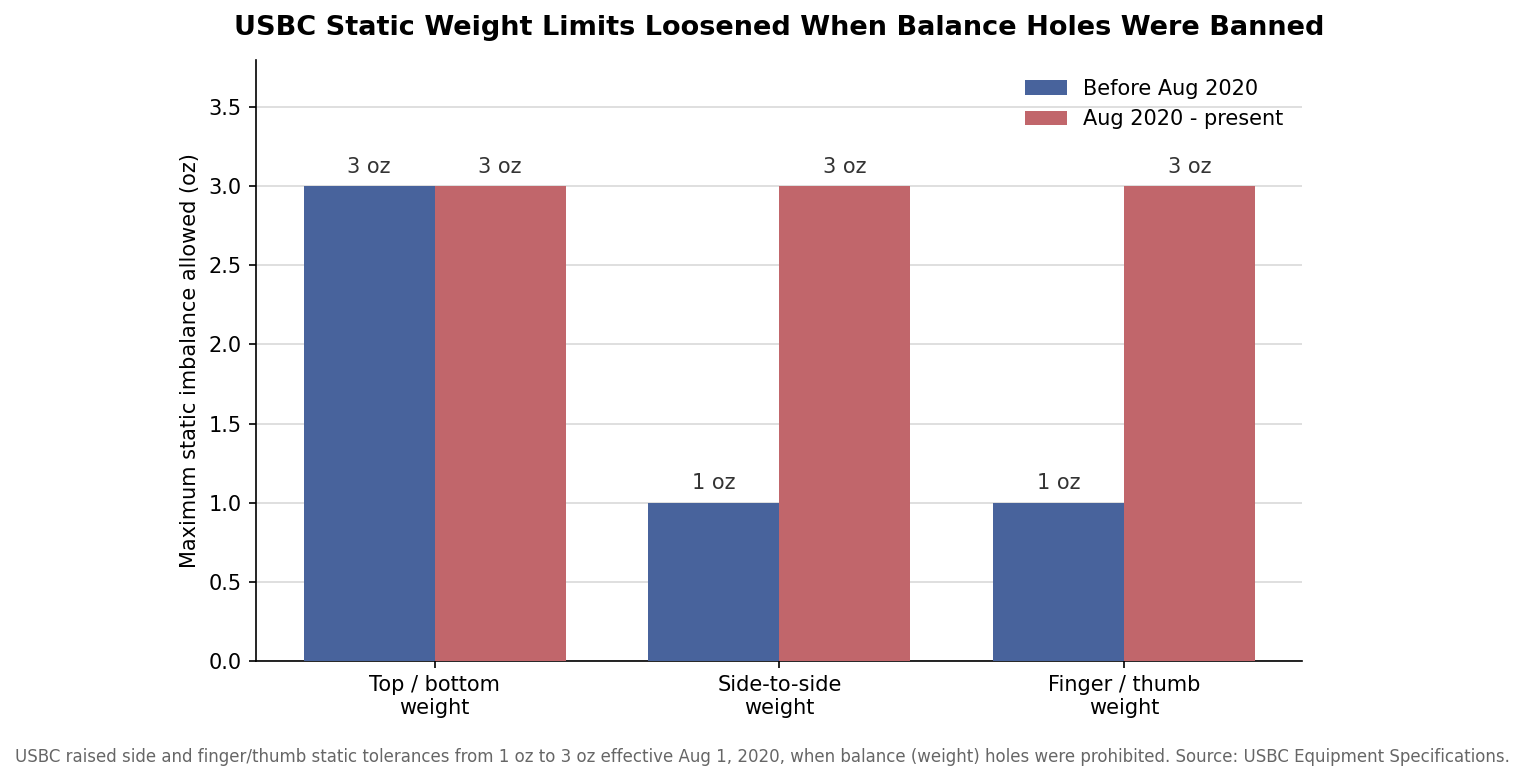
For a custom or bulk order this is mostly good news. It means a pro shop can fit and drill a personalized ball to your hand within a generous tolerance, and it means a ball ordered undrilled and drilled later locally will still pass as long as the driller sticks to gripping holes. The practical caution is simple: keep the layout to holes you grip, and skip the old habit of adding a balance hole.
The 2026 urethane rule that most bowlers can ignore
Beginning with events in 2026, the USBC tightened the rules on so-called slow oil-absorbing, high-performance urethane balls. Balls of this type must meet a 78 Shore D hardness minimum to be eligible for specified national tournaments, new manufacturing standards took effect December 31, 2025, and the tournament restrictions began January 1, 2026. Some marquee national events restrict or bar these balls outright, and urethane balls manufactured before August 1, 2022 are not eligible for national competition at all.
Here is the part that matters for almost everyone: these restrictions apply to USBC national championship events, not to local league play or most regional tournaments. If your custom ball is destined for a Tuesday-night league, a company outing, a fundraiser, or a pro shop’s rental rack, the 2026 urethane rule does not change what you can order. It only becomes a consideration for bowlers chasing entry into national-level competition, and even then it targets a specific slice of urethane equipment rather than reactive resin, which is what most league bowlers use.
What this means when you order in bulk
For a league buying matching balls, a business ordering branded equipment, or an event organizer outfitting a lane, legality comes down to two checks rather than a dozen. First, start with a USBC-certified ball, which any mainstream reactive, urethane, or plastic model from a recognized manufacturer already is. Second, keep the drilling to gripping holes and let a competent driller handle the layout within the 3-ounce static tolerances. Decoration is a non-issue; the engraving, the logo, and the color are cosmetic and sit entirely outside the specification manual.
Budget tends to track coverstock and drilling more than customization: plastic and spare balls sit at the low end, reactive resin and high-performance balls at the high end, and drilling is added per ball. Send your quantity and styles through the quote form for a firm number. A logo or engraving is a modest addition on top of the ball and drilling, and because it does not touch the specification limits, it never affects whether the finished ball can be used in sanctioned play.
The reassuring takeaway is that a custom bowling ball is not a special legal category. It is a standard, certified ball with your artwork on it. Buy inside the weight, size, and hardness limits, drill only the holes you grip, and the personalization takes care of itself.